

Unlike technical or operational training, the return on investment (ROI) from communication and presentation skills training isn’t always easy to quantify.
Whilst the value of being able to speak clearly and confidently in business is widely acknowledged, actually measuring its financial impact poses several challenges. But the need for professional workplace training in Australia has never been more important.
According to a recent study by CEDA (Committee for Economic Development of Australia), investment in employee training has declined steadily over the last 18 years.
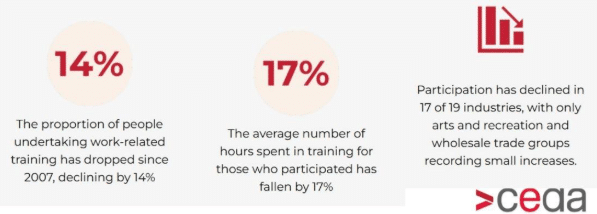
At the same time one third of all Australian occupations are suffering from a shortage of skilled workers. So, recognising and addressing this skills gap through professional development and training is essential for both business and economic growth.
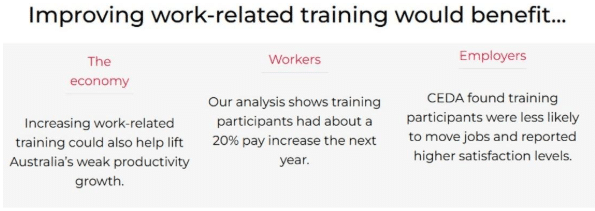
The same CEDA study also highlights the benefits of increasing work-related training for the economy as a whole, for workers, and for their employers.
So, what are some of the barriers faced by talent professionals that might account for this decline in employee training?
Challenges of quantifying the ROI of professional skills training
We know budgets are tight, and whilst soft skills (or, what we call at SecondNature, ‘professional skills’) often lead to benefits like stronger client relationships, increased employee confidence, and higher employee engagement – these advantages don’t always show up immediately on the bottom line.
Equally, some benefits take time to evidence. Improved presentation skills might only come into play when an employee delivers a presentation at a high-stakes meeting, pitches to a new client, or engages stakeholders involved in an important project. This could be weeks or even months after the training.
And progress in people’s communication skills is often measured through peer feedback, manager evaluations and self-assessment -all of which can vary depending on who and when the evaluation takes place. So, success is often subjective and traditional ROI methods can fall short of the task.
Yet, as you would imagine, it’s a question we frequently get asked by our clients.

Strategies to measure ROI of communications skills training
We encourage our clients to gauge success in three ways; at the individual level, at a team level, and at an overall business level.
Individual level
By far the most common feedback we hear from participants is: “This has been the most transformative training of my career – I only wish I’d done it sooner.”
Participants tell us every day that we have improved their confidence immeasurably (both professionally and personally) and given them the tools and skills to get their message across with clarity, credibility and impact. We’re not sure you can measure this type of outcome in terms of ROI because we would say that this outcome is priceless.
Here’s some other comments from recent workshop participants:
- 11/10. Life changing. I only wish I’d done this programme earlier!
- I have been presenting for 25+ years and this programme has completely changed my mindset. I have learned some fantastic techniques, that I will use in everything I do from now on!! Great Stuff!!
- I’m very, very critical. Nothing is ever perfect for me, but this training is! Completely exceeded my expectations!
- The best communication skills course I have attended (and I have attended a lot!).
- The training has completely altered the way I prepare for presentations, giving me the tools to properly communicate to my audience.
- Probably the best training course I have done – I cannot believe how much I have learnt and improved over the two days!
One of the most immediate outcomes we see in participants is greater self-belief. Whether it’s speaking up in meetings, presenting to senior leaders, or handling difficult conversations – employees feel more capable and composed.
They become skilled at tailoring messages for different audiences, are able to structure ideas clearly, and speak with confidence and credibility- so their ideas land well and lead to action. This helps them gain traction with peers, leaders, and stakeholders.
Learning how to be good communicator also involves understanding how to be a good and active listener. This skill allows them to respond to team members with empathy, and improve their workplace relationships.
We also find that many participants say the training benefits spill over into their personal lives – helping them feel more confident at events, with family, or in everyday leadership roles.
So whilst it’s hard to quantify these types of outcomes, we know that they can be career-critical and a business imperative.

Team level
Our Presentation Mapper™ framework transforms the way people communicate, especially when it comes to turning complex data into compelling stories. It’s designed to help teams inform, persuade, inspire, and drive action.
What does that look like in practice? Meetings become shorter and more focused. Messages are clearer, more concise, and purpose-driven. And that means decisions get made faster.
Not only that, but we regularly hear from participants that our Presentation Mapper™ saves them around half the time they used to spend preparing for meetings, particularly when building decks or shaping their message.
Whilst we’re not across our clients’ internal finance structures, there’s no doubt that communication and presentation skills training that leads to quicker preparation time, more effective meetings, and faster decision making, has a positive impact on the bottom line.
Business level
One of the key reasons for having a strong learning and development programme for staff is to drive engagement, enhance talent retention, and to support career moves across the company. All this, in turn, reduces flight risk and hence talent acquisition costs.
Of course, calculating the ROI here involves a few assumptions, but let’s walk through the logic. Say a company invests in a presentation skills training programme involving just 20 of its staff. Now let’s say the average salary per staff member is around $100,000. If just 5 of those staff members (i.e. 25% of a 20-person cohort) feel more engaged with their organisation as a result of the training, and on the back of that they feel more confident and empowered to explore a new job/career opportunities internally, rather than leaving the business, the savings start to add up. Assuming recruitment costs sit at 25% of salary, retaining those five employees could save the business around $125,000.
That’s a strong return by any measure! And that’s without factoring in the retained knowledge, team continuity, and cultural stability that comes with it.
Best practices for measuring ROI
Here are some smart, practical ways companies can track the business impact of training when investment is made in developing their people’s communication skills:

- Track confidence and performance over time
Start with a pre-training self-assessment, then follow up post-program. You’ll often see a meaningful lift in confidence, clarity, and communication effectiveness – especially when combined with feedback from managers or peers. - Observe behavioural changes
Look for changes in how people behave in meetings. Are they contributing more? Are their messages clear and well-structured? Do they have more presence and authority? Are they more engaging and impactful? Are they able to manage questions more effectively? These are powerful signs that their newly acquired skills are being applied. - Link to business outcomes
Track soft-skill improvements alongside business wins like improved team performance, faster decision-making, stronger client engagement, and increased sales.

- Measure time saved
When communication improves, meetings run shorter, presentation preparation take less time, and decisions happen faster. Multiply that time saved across teams, and the ROI becomes evident. - Monitor staff engagement, retention, and internal moves
Everyone knows that investing in people’s professional development can enhance staff engagement. We also regularly receive feedback that enhanced communication and presentation skills gives people the confidence to grow within the business rather than leave. So based on this, do the analysis to see how many people successfully apply for new roles within the business. You can then easily calculate the cost saving of harnessing internal talent rather than having to pay recruitment costs for external hires.
The headlines speak for themselves
“57% of Australian employers report that skills gaps are impacting productivity.”
Research by the Australian HR Institute indicates that over half of employers are experiencing productivity issues due to skills shortages.
“For every $1 cut from learning and development budgets, Australian businesses lose skills valued at $3.40.”
RMIT Online’s 2024 report highlights that reductions in L&D spending can lead to significant losses in valuable skills.
If you are in any doubt that investing in communication and presentation skills training can produce tangible business results then why not get in touch. We can chat through our wide range of in-person and online training programs and discuss how we could tailor a program specifically for you, your business, and your people.

For nearly 20 years, we have been known as the Business Presentation Skills Experts, training and coaching thousands of people in an A-Z of global and local organisations. We work with clients in just about every industry, and with people of every level. Check out what they say about our programs.